Pre-assessment and Differentiated Teaching Strategies

Students that are entering my 9th or 10th grade World History class will be presented early on with a pre-assessment that will help me identify the collective class knowledge level, students with strengths that need to be challenged, and students that may need supplemental support to help them meet the class requirements. Students will be divided into three tiers: those that answered 90% of assessment answers correctly, those that were in the 50% range, and those and performed poorly. By tiering students, I will be able to ensure that everyone is being given materials in resources that are both challenging and realistically obtainable.

Students that fall into the highest tier will be given additional resources meant to challenge their existing understanding of the subject material. The priority for these students is to ensure that they are consistently challenged and engaged in course. It can be easy to identify that a student is doing well, reprioritize their needs, and forget that they need a constant influx of challenging information and activities to maintain their engagement level in the class. The last thing that I want is a student to under-perform because they became bored with the activities and instruction that I am provided. These students are also prime candidates to take leadership positions in heterogenous grouping exercises. They will be able to reinforce their own knowledge as the help their peers learn.

Students whose pre-assessment results place them in the secondary tier will be given activities and assignments that reinforce their existing knowledge, and allow them to continue to develop the skills critical to passing the class. These students will be given additional resources that re-define the high level concepts of the unit and further solidify a holistic understanding of the subject.

Those students that fall into the tertiary tier will receive activities designed for intensive course-correction. They will review the extremely high-level concepts, making sure that the basics are understood before being introduced to material that builds skills for which they aren’t yet prepared. These students will also participate in heterogenous groups and be given the opportunities provided by peer collaboration and learning.

A visualization of this compartmentalization can be found here.
Assessing Project Based Learning

Teach-Now Module 5 Unit 2 Activity 1

Assessing Project Based Learning

William Ross

Grade 10

World History

The Revolution Project

Overview

This project works in tandem with a unit on historic revolutions, their causes and outcomes, and lasting effects. Throughout the project, students will work on group projects in which they become familiar with famous revolutions, analyze their effectiveness, and present arguments either against or in defense of a revolution and its ramifications. Students are assessed via multiple forms of formative assessment and a formal formative assessment, all of which build to an end of unit summative assessment based on the educational standards for the course.

Description

An Effective Revolution

Driving Question: What are the elements of an effective revolution?

Students are placed into groups of six. Groups are assigned countries, all of which have significant socioeconomic disparity and inequality among the population. Each student is assigned a role. Each role represents different social classes, professions, and privileges. Students are given primary and secondary resources to help solidify their understanding.

Identifying as their role, each student builds and presents to their group an argument describing the changes that they believe would be necessary for a just and democratic society. These changes can be in the form of taxation, legislation, strike, and revolution (among others). Each student provides sources for their argument.

Goal: Students will learn about the conditions, beliefs, and triggers of historic revolutions.

Each group then collaborates to build a coherent synopsis of their country’s current socioeconomic reality and the steps that they deem necessary to change it into a society that is fair and functional. Students identify the owners of roles, including speaker, researcher, and writer, and begin to work on their overall argument. While the project is developing, students are given the opportunity to meet with individuals from other groups that share similar roles to get their feedback and advice on ways to better formulate their positions. The project culminates in group presentations where they deliver their oral arguments, along with historic context, to the class.

Formative Assessments

Exit Ticket:

What do you believe is the most important aspect of a fair and just society?

Analysis: Exit tickets are collected by the teacher and analyzed to ensure that students are becoming familiar with the fundamentals of revolutions and their purposes.

Quote:

Students are given a quote from a famous historic revolutionary and asked the following questions:

What does this quote mean to you?

What does this quote tell you about the author’s opinions on revolutions and their leaders?

Based on what you know about revolutions, do you agree with this quote?

Students are given time to formulate their responses which are then collected by the teacher and analyzed to ensure students are developing a well-rounded understanding of historic revolutions, their triggers, and their leaders.

Project Assessment

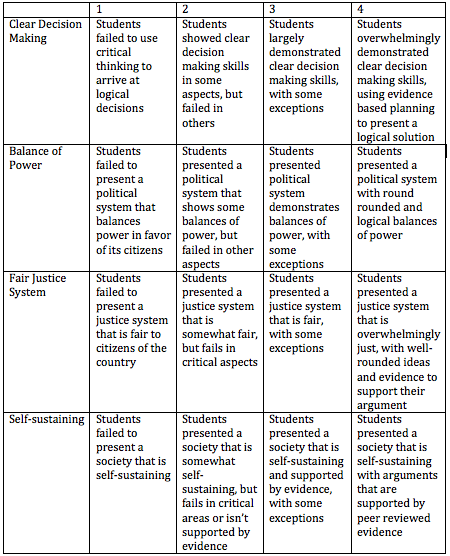
Each group is assessed by the teacher and other groups based on the following criteria (each a 1-4 scale, 1 being the weakest point value)

Formative Assessments and Peer Feedback

Formative Assessments are an extremely important tool that I plan to utilize throughout all of my classes. Due to the fact that I am not currently teaching, in lieu of reflecting on the implementation of my formative assessments, I will discuss the feedback received from my peers and how it will help shape these assessments for when they are officially implemented next academic year.

The first formative assessment that I analyzed is a pre-unit activity called “Brainstorming”. By simply asking the class, “What do you all know about [x]?” and allowing the students to submit their answers in an open forum, I will be able to get a feeling for where the class stands as a whole on a particular topic, allowing me to tailor my lessons to ensure that my students are both engaged and challenged. A piece of feedback that I received from a colleague was that my baseline questions should start at the “beginning” of the subject. For example, if I were  beginning a unit on World War I, instead of asking my students “Who made up the Central Powers?”, I should ask something more fundamental, such as “Were Germany and France on the same side?” Although this formative assessment is a great tool to understand where the class stands, if I set the goal posts too far, I will only be able to learn a fraction of the meaningful information that I would otherwise.

Standing at the other end of in-class formative assessments are Exit Tickets. Exit Tickets aren’t a new idea and I absolutely plan on using them in my classroom. However, I think it is very important to understand the capacity for exit tickets to become predictable, unengaging, and counter productive. Exit Tickets are designed to give you an immediate glimpse into a student’s understanding of the subject. Should a teacher make it a part of their daily lesson, the students will come to expect them and potentially only “learn to the test” in a day to day scenario. I plan on utilizing exit tickets once a week and rotating the day they are used. The ultimate goal is the quality of information a teacher can learn from a formative assessment and I would like to put myself in a position to utilize them to their potential.

As a future teacher, I am excited to learn more about formative assessments and their ability to monitor student progress in a student-first, growth-mindset oriented project based learning environment. Student collaboration towards a common goal allows young learners to not only learn the subject matter, but build 21st century skills. It is only be assessing these collaborative efforts that I can ensure my students are on track to succeed in my classroom and grow academically and socially.